

25/10/2026
Emma Monk (Monk Debunks)
Join 71,384 others who are taking action to share the truth & raise standards in the press
First published on the "Monk Debunks" substack, which you can subscribe to here.
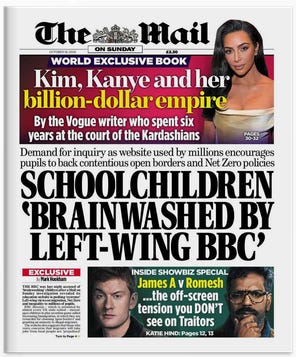
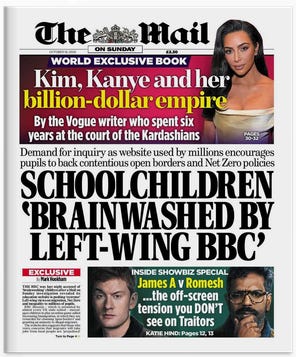
The article accompanying this Mail on Sunday (MoS) front page is an absolute masterclass in extreme cherry-picking and context stripping in search of the ultimate rage-bait headlines.
Having read the article, I went to the source to see what BBC Bitesize was actually putting out there, but unfortunately found that every section mentioned in the article appears to have been replaced with either a “404:Not Found” or a “This content is currently under review” placeholder.
Fortunately, most of it is on the Web Archive, so we can see the all-important wider context of every example used by the MoS.
Unfortunately, the main complaint refers to a BBC Bitesize game about immigration, and that section has been removed from both their own platform and the Roblox game platform that hosted it, so I am unable to look at those specific details. But I have the teaching resource, pupil resource, and screenshots used by those outraged at the game, so we can take it from there.
Today’s debunk is going to be a sort of call-and-response. What the MoS said (in grey box quotes), followed by the reality, the context or the facts.
The MoS says their “investigation reviewed material on BBC Bitesize for pre-GCSE secondary school pupils aged 11 to 14.”
For those who don’t know it, BBC Bitesize is an online educational resource used in most schools, covering all ages up to 16 and all mainstream subjects. It is used by over 80% of secondary school pupils, and registers 1.7 million browser visits per week.
Of the 21 curriculum areas, the MoS appears to have focused only on topics that can feed into culture wars: immigration, net zero and political campaigners.
So let’s look at what they highlighted as “left-wing brainwashing” and see what context was missing.
BBC Bitesize have created a Geography game, where students have to explore multiple scenarios and make decisions with differing costs and payoffs to try to balance out the environment, the economy and population wellbeing.
The 14 mini-game scenarios on Roblox cover everything from rivers and tectonics, through to urbanisation and population and migration.
The Population and Migration section has two games (I have taken their descriptions from the teacher materials associated with each game):
The MoS never mentioned the ‘dealing with emigration’ game, where the aim is to improve the local infrastructure to try and stop people migrating to other countries.
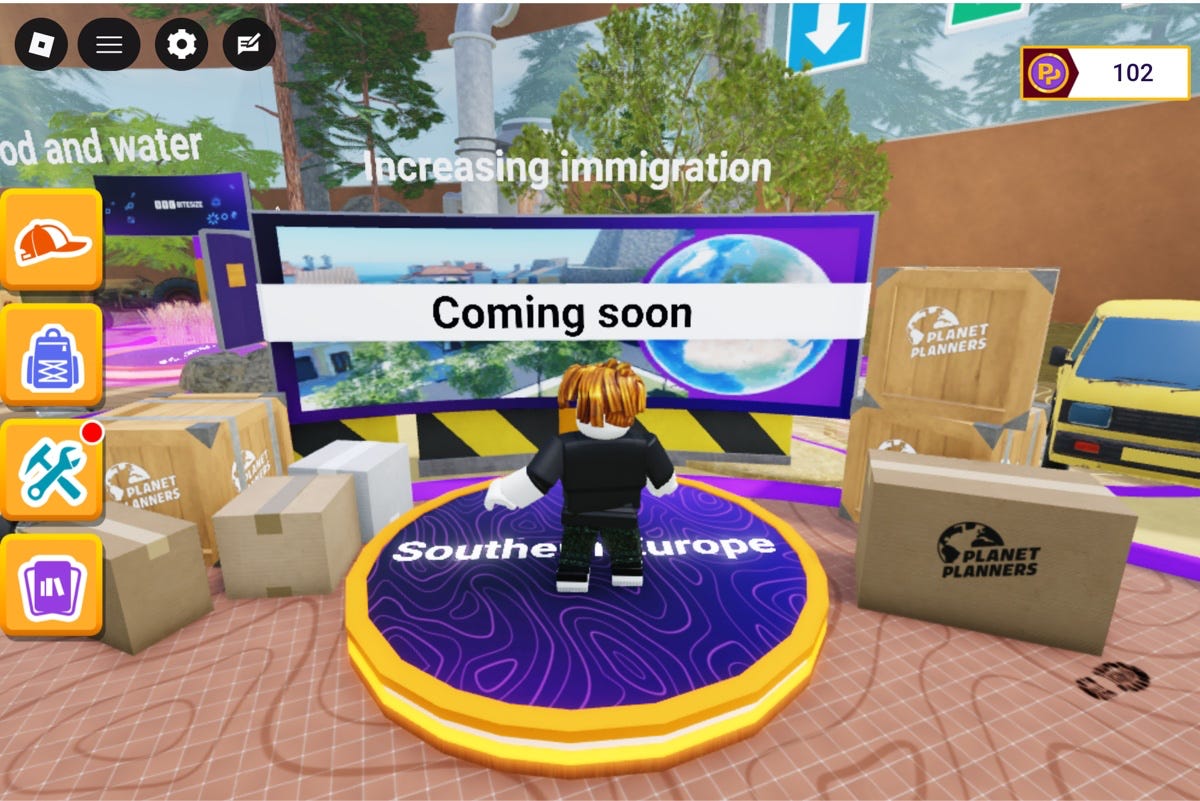
They only focused on the ‘increasing immigration’ game, where the purpose of the game is to increase immigration. It is not a game looking at whether immigration should be increased; it is specifically dealing with how you increase immigration, while balancing multiple factors, for a country which has chosen to do so.
So with that in mind, let’s look at what they wrote…
In one extraordinary example, pupils are encouraged to play a game called Increasing Immigration, making decisions aimed at boosting the number of incomers.
Yes, this was one of 14 geography games pupils are encouraged to play.
Each option comes with a budget ‘cost’ and once they’ve chosen, they find out the effects on the economy, public health and the environment.
This is true. Each decision costs different sums of money and will have differing impacts on those three factors. The key decisions they were asked to explore in this game were:
Instructions for the game, hosted on the Roblox platform, state: ‘We don’t have enough people of working age to keep our society running smoothly. We should try to attract migrant workers and incorporate them into our economy.’
This game reflects the political realities facing both Southern and Eastern Europe. As this 2025 report highlights:
By 2050, working-age populations are projected to decline in 22 out of 27 EU countries, while the share of those aged 85+ in the EU as a whole will more than double. This shift will strain healthcare, pension and long-term care systems across the continent. Eastern and Southern EU countries will face more severe ageing and workforce shrinkages, undermining their competitiveness and potentially contributing to increasing inequality.
Just as the emigration game reflects the political realities facing many developing countries. Neither game is “left-wing brainwashing”. They both highlight the difficult decisions and trade-offs faced by policymakers in different countries.
In one scenario, pupils are told that ‘a few’ immigrants are living here without proper visas or permission and can either deport them or grant them an amnesty. If they choose deportation they will lose one point on the economy and one on public health – and are warned: ‘This can be potentially dangerous for them [the immigrants]. Don’t expect this to be unchallenged!’
But those who opt to grant an amnesty are told ‘this will make them very happy’ and win two points in the same categories.
Given that the game is about increasing immigration, and that deportation can indeed be dangerous and is very often challenged legally, those seem like reasonable responses.
In a second scenario, geography pupils are told that allowing people to pass through the border easily ‘could really help grow our economy’. They are offered the option of ‘open borders’ – which results in their economy score rising by three points and public health by two points – or to vote that such a policy would be ‘too radical’, winning them no points.
Those who opt for open borders receive the optimistic message: ‘I’m excited to see where this goes!’ In contrast, pupils who select ‘too radical’ are told: ‘Perhaps you’re right to be cautious.’
Unfortunately, because the game has been taken down, I cannot find the section referring to ‘open borders’.
GB News and TalkTV ran multiple segments discussing the game and used various screenshots from the game, but none included any mention of ‘open borders’, nor did the Daily Mail piece. Given they all ran with the ‘open borders’ claim, it seems odd none of them showed that part of the game…
The closest I could find was a screenshot on another YouTube video, seemingly taken from the game, where they lay out the pros and cons of three different approaches; An Open Doors Approach, Balanced Integration, Cautious Limits.
Interestingly, in a TalkTV piece, while saying “if you choose the Conservative policies you get deductions”, they were sharing a section of the game where increasing border security cost more but also gave you more economy and public health points - entirely debunking their own argument!
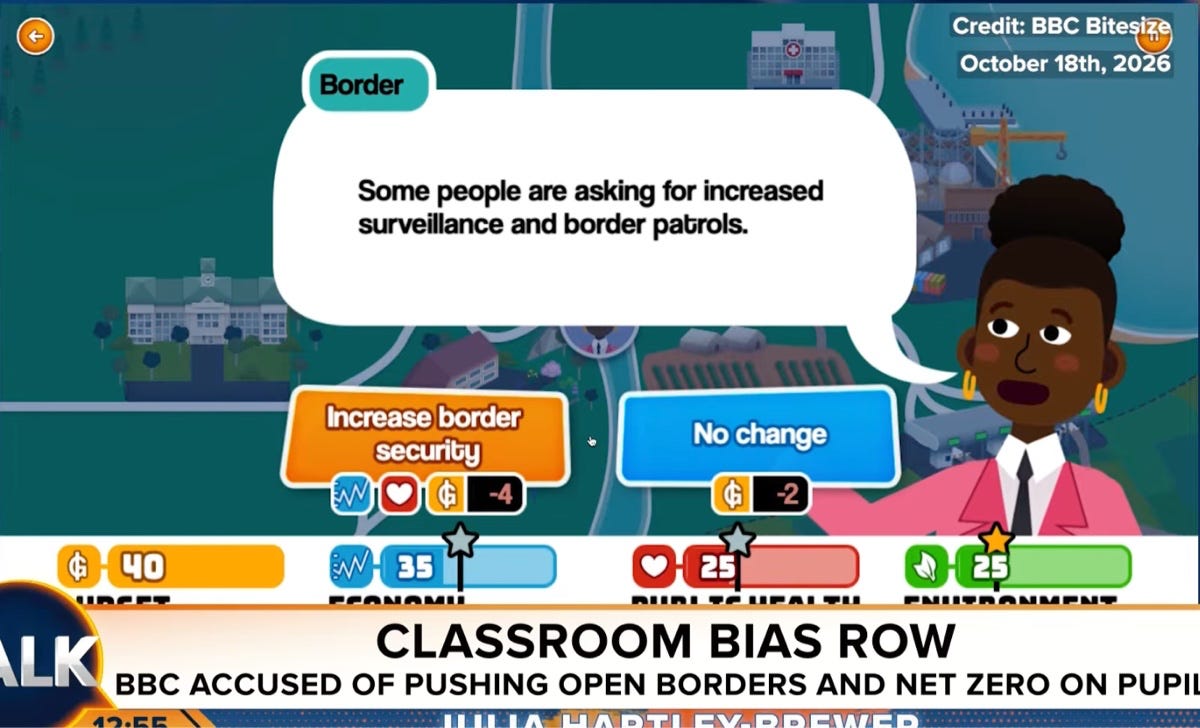
Accompanying material for teachers explains the game is set in ‘Southern Europe’, although this is unclear when playing.
I’m not sure what was unclear; certainly on the Roblox version of the game, it was perfectly clear the game was set in Southern Europe, as was the teacher’s lesson plan.
As I was unable to play the “increasing immigration” game, I had a go at the “dealing with emigration” game, where I had to make difficult decisions around investing in training and infrastructure, being more expensive but with better payoffs, and whether to focus on tourism or textiles to support the local Madagascar economy.
I played another game on the environment, where I was asked whether to build a solar farm (more expensive, better for public health and the environment) or expand oil and gas production (cheaper, more economy points, but worse for health and environment).
It all seemed like a pretty fun way to get kids thinking about difficult problems facing policymakers around the world, and the various choices and trade-offs available.
Of course it wasn’t suggesting any easy, populist solutions - because it is trying to educate and encourage children to critically evaluate real choices, not culture war sound bites!
Moving on from the game, the MoS appears to have scoured the entire BBC Bitesize website looking for anything they can use for this culture war rage bait piece.
Elsewhere on the Bitesize website, learning material is littered with contested claims about the economic benefits of migration.
Citizenship pupils in Northern Ireland are told that while immigrants can put pressure on housing and hospital waiting lists, they also ‘contribute more in tax income that they use in services’ and ‘make a significant contribution to the economy: they fill skills gaps, pay taxes, and spend money’.
Studies in Northern Ireland have shown that to be true. It should not be seen as “left-wing brainwashing” for the BBC to convey accurate information in their education pages.
Geography pupils in Wales, meanwhile, are told that migrants pump a ‘staggering amount of money’ into the economy.
This came from a video about immigration into Wales, on a page that highlighted multiple pros and cons of migration, alongside a section on conflict caused by immigration.
The section of the video it was pulled from said:
Migration has its drawbacks, of course. From pressure on public services to tension between migrants and the local population. But it can also bring great benefits. Migrants tend to be young - between 18 and 35 - which can revitalise areas of the country with ageing populations. And then there’s the staggering amount of money migrants pump into the economy each and every year.
With so many competing factors, it’s no wonder that the debate around migrants rages on.
Again, that shouldn’t be a controversial thing to say. It feels like a fairly balanced view.
The website does not, however, make clear that the economic impact of migrants varies greatly depending on their skills and the type of visa they have been issued.
Those on skilled worker visas do contribute more in tax than they use in services but care workers and the immigrant relatives of British citizens have a negative fiscal impact, Oxford University’s respected Migration Observatory has found.
Sure, but these resources are aimed at 11 to 14-year-old children and are just beginning to introduce these topics. They’re not yet at the stage of looking at the detailed comparisons of how much tax low-paid workers pay.
It is also worth pointing out that people contribute to an economy in multiple ways, not just by how much tax they pay. They buy things, support local businesses, they pay rent, they pay NHS surcharges and visa fees, and in the case of care workers, they fill jobs that need doing on low wages, which is in itself supporting our economy.
The Northern Ireland study material also states: ‘Some people may think that migrants take jobs from local people. This view likely arises from prejudice.’
Some context is clearly needed here.
This comes from a section called “Causes and consequences of conflict” on the “Living in a Diverse Society” page
Conflict can happen on a local, national and global scale.
An increase in the number of people in a particular area can put pressure on public services such as housing and hospital waiting lists.
However, immigrants contribute more in tax income than they use in services.
There is evidence of prejudice against immigrants across Northern Ireland.
A 2018 headline from the Belfast Telegraph reads:
Racist crimes outnumber sectarian incidents in Northern Ireland in past year
This is despite the contribution that migrants make to Northern Ireland’s culture and economy.
Again, that seems to be a good, balanced look at what causes conflict and why. It explains that immigrants expand the economy and so create more jobs than they fill.
Another part of the website lists twice as many benefits for migration compared to disadvantages.
This is true. While the Welsh version gave equal numbers of pros and cons and the Northern Irish version didn’t have lists in that format, the version for English schoolchildren did list 4 pros and 2 cons on their page looking at why people migrate, push and pull factors, and the impact on the countries they leave and the impacts on the countries they move to.
Shockingly, I know, but being impartial does not mean educators have to come up with and equal number of points in each column.
This one is a prime example of context stripping.
BBC Bitesize also appears to be advocating a world without borders. A video for Welsh geography students states: ‘As technology evolves... the question remains: can we learn to live with globalisation? And with it, fulfil the promise of a truly borderless world.’
The transcript from the video on Globalisation gives the context.
It explains how “Our world has ‘shrunk’. Internet communications can pass freely over borders, bringing us all closer together.” It explains how global trade, and easy and cheap travel have opened up opportunities that didn’t use to exist. It also discusses the downsides such as pandemics and how it can “steamroll over the thousands of cultures that make up our planet.”
It ends with the summary:
Without globalisation, institutions like the United Nations could not exist. Then there’s the environmental impact of globalisation. Free trade and open borders naturally lead to more travel, and more pollution. The arguments about globalisation could rage all day. But it’s a process that’s still fairly new. As technology evolves and we evolve with it, the question remains: can we learn to live with globalisation? And with it, fulfil the promise of a truly borderless world.
By open borders, it means we can now visit countries that were once inaccessible. And the rhetorical question at the end clearly isn’t “advocating” for a literal world without borders.
Former BBC boss Mr Cohen added: ‘Parents ought to be deeply concerned that the BBC is encouraging children to conform to extreme ideas such as open borders. It is yet another unacceptable failure of the BBC’s requirement to ensure impartiality.’
The BBC is not “encouraging children to conform to extreme ideas such as open borders”. The term open borders here simply means being able to travel across borders, and that internet use, global trade etc isn’t limited by borders.
And here we see just how far the Right have gone, to suggest that net zero, a goal being aimed for in over 135 countries worldwide, is somehow contentious.
A video on the website also describes the contentious Net Zero policy as an ‘important goal’ and suggests that pupils could ‘petition your local government to act’.
Yes, a video on Net Zero says:
You may be able to do some of those things on your own, but by working together with other people, you can have an even bigger impact.
How about working in your own community by asking schools or businesses to go carbon neutral?
Could you petition your local government to act on the issue?
Another video, for students in Wales, states: ‘For us to reach Net Zero in Wales, we’ll have to do things differently. We may need to fly less, eat less meat or stick to sustainably farmed meat.’
True, in this video on Net Zero they list a number of changes that can be made including using less energy and switching to renewables, in amongst a conversation about net zero, being carbon neutral, and the dangers of greenwashing.
But mainstream politicians have rejected that idea. Sir Keir Starmer last year said tackling climate change ‘does not mean telling people how to run their lives’.
And nor does that video. There is some serious straw clutching going on in this MoS piece!
BBC Bitesize material also hails a string of Left-wing and progressive ‘political’ icons, including climate activist Greta Thunberg (pictured) and 1980s campaign group Lesbians and Gays Support the Miners
To be fair, the MoS aren’t wrong here. Under the Politics and Democracy section, they have a page of Welsh political icons:
I would love to know what Right-wing Welsh icons the MoS think should be in that list instead?
A video asks if pupils joined Ms Thunberg’s school protests, when pupils skipped Friday classes to campaign against climate change.
That seems like a fair question when discussing the school climate strikes that took place across 128 countries and involved a reported 1.4 million children.
Elsewhere it says that a statue to US anti-slavery campaigner Frederick Douglass in Belfast is a ‘reminder that anti-racism movements such as Black Lives Matter in Belfast and across Ireland are one with the movements of the rest of the world’.’
Yes it does have a section on Belfast and its role in abolition. Who knew that recognising anti-slavery campaigners is now considered to be “Left-wing brainwashing”
The website also says Black Lives Matter ‘campaigns for freedom, justice and equality’. It does not, however, acknowledge how the movement in the UK became highly contentious after it was hijacked by far-Left activists who want to tear down capitalism and abolish the police.
There is a paragraph on Black Lives Matter on a page about “The struggles against racism and for human rights”. And no, it doesn’t go into the ins and outs of minority factions apparently hijacking a global movement, because, again, that is beyond the scope of an introduction to anti-racism movements aimed at 11 to 14 year olds.
In another video about reducing inequality, the presenter states that ‘the world becomes a fairer place when we take every cause as our own’ and, over footage of a Pride flag, says ‘I will always be an ally to those shouting for equality’.
It also shows demonstrations featuring placards emblazoned with ‘Black Muslim Lives Matter’ and ‘Refugees Welcome’.
This video is on the “UN Sustainable Development Goal 10: Reduced inequalities” page, which, like all the other pages we’ve discussed, has had the content removed.
Just take a second here to register that it appears that the BBC has removed their factual content on the UN Sustainable Development Goals because the Daily Mail thinks that’s “Left-wing brainwashing”…
In a different section about slavery, Bitesize tells pupils to ‘join and campaign’ with groups such as Amnesty International.
Yes, this is the “What can I do” section following a discussion about modern slavery and forced labour happening today:
You can start by looking at what companies use human trafficking and slavery to produce their products and purchase an ethically produced equivalent instead.
You can join and campaign with advocacy groups such as Anti-Slavery International and Amnesty International, which aim to end slavery throughout the world. These organisations lobby governments - including the UK - to change policies and laws that put people at risk of slavery. They also raise money to help people escape slavery and monitor the prevalence of slavery around the world.
The UK arm of the charity was widely criticised earlier this year after describing gender-critical organisations and a woman’s refuge backed by J. K. Rowling as ‘anti-rights’ groups. It later withdrew the report and referred itself to the Charity Commission.
That’s true. Amnesty International UK’s apology can be found here. I’m not sure accidentally publishing a document in the UK, taking it down within 48 hours and offering a full apology, is really a reason to suggest their work on tackling modern slavery is not something teenagers should be told about.
The quotes the MoS got for this piece are bordering on the unhinged…
Shadow Education Secretary Laura Trott: ‘The BBC has crossed a line,’ she said. ‘They have a duty to remain impartial, and yet they are using learning tools as a vehicle to push a Left-wing political agenda onto young children. Advocating open borders encourages illegal small boat crossings. These are the type of toxic resources dressed up as education which should be nowhere near the classroom.’
Alex Burghart, Shadow Cabinet Office Secretary: ‘The BBC was set up to inform, educate and entertain –- not misinform, re-educate and brainwash.’
Former Tory Education Secretary Gavin Williamson MP: ‘The mask has slipped and the BBC has yet again betrayed its rampant Left-wing political agenda. The state broadcaster brainwashing children using a homework game is like something from a North Korean re-education camp.’
“Rampant Left-wing political agenda”, “North Korean re-education camp” and “brainwashing” - those are the terms they are using to describe children being taught about science, geography, history and politics.
It should not be controversial to explain to children that migration has positives and negatives for both the receiving country and source country, that Greta Thunberg is an iconic political figure, and that Amnesty International is a leading campaigner against modern slavery. But here we are!
I hope this has left you better able to spot when these kinds of articles set out to cherry-pick words or sentences that can be stripped of all context and dished up to fuel outrage.
I am so disappointed that the BBC have removed entire sections on Net Zero, Migration, the Slave Trade, and even the equality UN Sustainable Development Goal, because a right-wing newspaper wanted to launch an unfounded attack on their impartiality. I really hope those pages will be up and running again soon.
I would suggest that it can only be considered “biased” to teach children facts, when your worldview is based on a fictional, populist reality, where nuance doesn’t exist, science must be ignored, and being against slavery is a bad thing.
First published on the "Monk Debunks" substack, which you can subscribe to here.
Hacked Off is funded by supporters, not newspaper owners. Help us take this to Parliament: give £10 a month.
Give £10 a monthBy submitting your details you agree to receive email updates about the campaign. We will always keep your data safe and you may unsubscribe at any time.