

.png)

.png)

.png)


29/06/2026
Nathan Sparkes
Since the Leveson Report was published in 2012, exposing a collapse in ethical standards across the press, most national newspapers have adopted a similar stance: objection to the very principle of accountability.
They believe that while social media, broadcast media and every other industry should be regulated, they alone should be permitted to operate and break their own code of conduct without any oversight. As a result, they have continued to harass ordinary people, intrude on the lives of children and victims of crime, and spread disinformation with impunity.
Despite multiple ethical breaches, newspapers have been indulged by a series of Prime Ministers who have put their interests first, in the hope of obtaining favourable coverage in return.
Keir Starmer, the outgoing Prime Minister who gifted the press a reversal of longstanding Labour policy to obstruct action on regulation and Leveson Part Two, was the latest politician to prove that this strategy is as naïve as it is morally bankrupt.
There is now hope that Andy Burnham, who is widely expected to become the next Prime Minister, will finally put the interests of the public before the interests of a handful of powerful publishers, and introduce modest standards of ethics and accuracy for national newspapers.
This has clearly caused panic at The Telegraph, who have published a report packed with falsehoods.
Taking aim at efforts to introduce standards in the national press, it fails to declare a striking conflict of interest: The Telegraph's Deputy Chairman, Lord Black, is also on the board of the Regulatory Funding Company, which controls the rules of the press' current sham complaints body "IPSO".
Key lines follow below with rebuttal.
Hacked Off Hugh Grant pushes Andy Burnham to curb free speech: Labour considers new war on journalism and social media
Independent press regulation would protect journalists and enhance free speech. Only press abuse would be curbed.
This would not be a “war on journalism”. Action on press standards is widely supported by journalists themselves. Most reporters rightly take pride in their work and want to abide by a Code of Conduct that is treated with contempt by editors and proprietors.
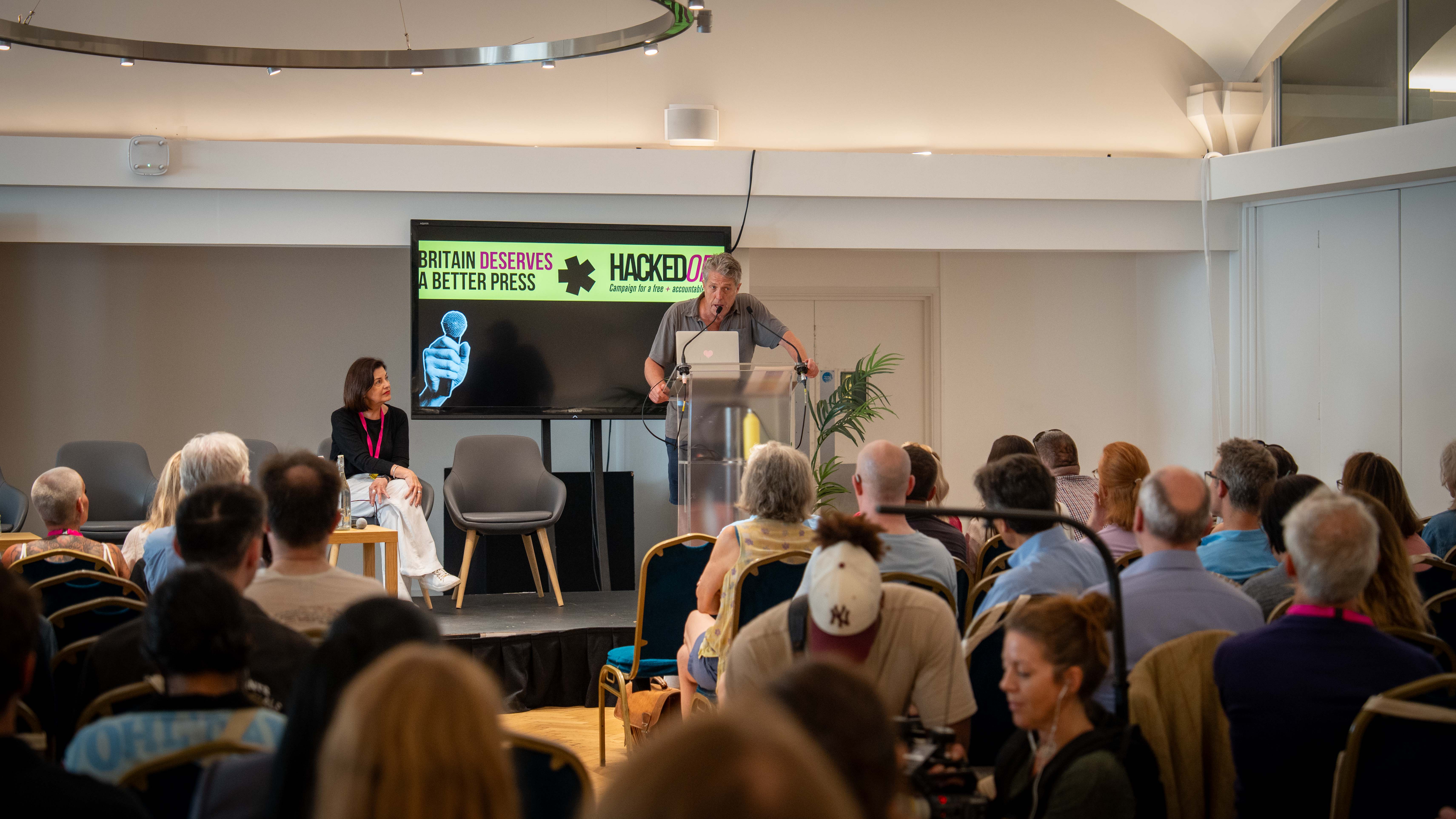
In a sweltering Westminster basement at the peak of last week’s heatwave, Hugh Grant, looking relaxed in shorts and loafers, was in an optimistic mood.
“As we switch leadership of the Labour Party, switch prime ministers, there’s a chance finally to get something done,” the actor and press regulation campaigner told a gathering of like-minded activists.
“All I say to whoever is the new prime minister is when you’re weighing up whether to do the right thing for the people against a massive corporation or to cosy up to those giant corporations for your own political career, bear this in mind: those media organisations are going to pour a bucket of s--- over you whatever you do. Whether you support them or whether you don’t.”
Grant, who also goes by the online handle @HackedOffHughin reference to the well-funded campaign group Hacked Off, is not a lone voice of optimism in these circles as Andy Burnham prepares for power.
Hacked Off employs a handful of part-time staff. Added together, their time represents approximately one fulltime employee. It has no office.
(The Telegraph’s profits last year were in excess of £54m).
For 15 years, Hacked Off has demanded state regulation of Fleet Street.
Hacked Off campaigns for independent regulation of the press, totally independent of both politicians and representatives of the press.
It still wants ministers to push ahead with the second part of the Leveson Inquiry into the culture and ethics of the press, which was launched in the wake of the phone hacking scandal at Rupert Murdoch’s newspaper empire.
We do – along with about 80% of the public, according to opinion polling.
Yet their calls have met resistance across successive governments. Matt Hancock, the culture secretary at the time, confirmed in 2018that the second phase had been scrapped. Sir Keir Starmer in his first month in power ruled out a Leveson revival.
Grant, who was accompanied by the former X Factor judge Tulisa Contostavlos at last week’s event, salted his optimism with a frustrated lament for the outgoing Prime Minister.
“If ever there was a case in point, it’s Keir Starmer, who last week was at the Murdoch summer party pretty much wearing a bucket ofs---,” Grant said.
“So this is a chance for someone new to be – in my opinion – a statesman instead of a politician, to govern instead of just playing Westminster snakes and ladders, to protect the public rather than protect vested interests. So let’s hope this is a hopeful moment – it just might be.”
Hope on hope. As Team Burnham prepares to sweep into No10, is @HackedOffHugh really on the cusp of a historic triumph over his tabloid tormentors in the form of state control of Britain’s free press?
Hugh Grant has never expressed support for “state control” of the press. He, and Hacked Off, have campaigned for effective and independent self-regulation as recommended by Leveson.
What is certain is that press regulation is just one item on a lengthy list of unresolved policy questions facing Burnham.
…
There’s plenty of encouragement for Hacked Off in Burnham’s political past, too. He has been a proponent of Section 40 of the Crime and Courts Act 2013, legislation designed to force news publishers to join a state-backed regulator.
Section 40 would have protected large and small publishers from “SLAPPs” and the risk of expensive litigation at the hands of wealthy and powerful individuals, provided they joined an independent regulator. And it would have protected ordinary people from abuse by wealthy and powerful publishers.
But national publishers were more concerned with protecting their power and control than serving the interests of journalism or the public. And because the previous government was more concerned with keeping the national publishers onside, they repealed the provision.
Under the measures, publishers would have been liable to pay all legal costs in libel or privacy lawsuits, even if they won, unless they were a member of such a regulator.
This would only apply if the judge deemed such a costs award to be fair in the circumstances.
The laws were ultimately formally repealed by the Tories under the Media Act 2024, before they were ever brought into force.
As shadow home secretary under Jeremy Corbyn’s turbulent Labour leadership, Burnham was a vocal supporter of the proposed second stage of the Leveson Inquiry.
It was envisaged as an investigation of the relationship between the press and the police, which has become unrecognisably distant since the phone hacking scandal engulfed Rupert Murdoch’s titles in 2011.
There is no evidence that relations between parts of the press and the police have improved. In any case, Leveson Part two was envisaged as far more wide-ranging than that: a forensic examination of how widespread unlawful and unethical conduct was, whether editors and proprietors were aware of the misconduct, and to what extent the police colluded with journalists.
Burnham said in 2016 that part two of Leveson was “non-negotiable”, seeing it as intrinsically linked with campaigning on the 1989 Hillsborough disaster, which was subject toa police cover-up that was promoted in parts of the press.
Byline Times, an online publication that campaigns for press regulation, reported that Burnham said in a chance encounter at Leeds railway station in March that “I haven’t given up on [Leveson part two]” and would do it “if he had the influence”.
Well, he has now. The writer of the Byline Times report, Adrian Quinn, a press regulation campaigner of the University of Leeds, said: “I take him at his word – he said he would and we shook on it.”
Dr Quinn is an academic and expert on the media. Like the vast majority of experts on the subject (and the general public), he supports action to raise standards in the press.
Celebrities including Grant, Sienna Miller and JK Rowling lined up to testify about their treatment at the hands of what they portrayed as a rapacious British press.
Also, dozens of victims of crime and people who are not “celebrities”. 69% of phone hacking victims were not well known.
Rupert Murdoch and his younger son James were grilled about their knowledge of illegal practices at their newspapers, as well as the subsequent cover-up.
Executives, including Murdoch’s closest British lieutenant, Rebekah Brooks, and Paul Dacre, then editor of the Daily Mail, gave evidence. Even David Cameron, the former prime minister, was questioned on his dealings with the press.
The result was a 2,000-page report that eviscerated the culture of the press, concluding that journalists had caused “real hardship and, on occasion, wreaked havoc with the lives of innocent people”.
Lord Justice Leveson’s key recommendations included the scrapping of the industry-funded Press Complaints Commission and formation of anew regulator underpinned by statute.
The press fought against any form of state involvement, viewing it as anathema to Britain’s history of free and independent journalism. Publishers mounted an ultimately successful campaign to repeal Section 40, the law written to force them to submit.
Leveson’s proposals did not involve “state involvement” in regulation itself. He was clear that self-regulation should continue, but on terms that guaranteed independence from the industry and independence from political influence. This is the complete antithesis of IPSO, the complaints-handler set up by The Telegraph & other publishers, which is owned and run by the industry and has politicians involved at various levels.
The regulator Impress, which is recognised by the Government and underpinned by a Royal Charter, has failed to secure the buy-in of any major publisher. Meanwhile most of Fleet Street is signed up to the Independent Press Standards Organisation (Ipso), a self-regulatory body, which they fund.
IMPRESS is not “recognised by the Government”. It meets the criteria for “recognition”, which verify that it is independent and effective. These are overseen by an independent body, the Press Recognition Panel (which has repeatedly found IPSO to be unfit for purpose).
Regardless, the news business has completely transformed since Leveson’s report was published in November 2012, and not only in its dealings with the police.
The reach, influence, and regulatory arrangements have not changed in any substantive way at all.
Tabloids in particular, the target of most of the criticism in Lord Justice Leveson’s opus, are nowhere near the cultural or financial force they were a decade ago. The bundle of crime, celebrity gossip, sport, humour, soft pornography and games which built their power has unravelled in a digital explosion of choice.
This is not true.
Of the 17 most popular news websites, 11 of them are owned by newspaper-style publishers (Ofcom News Consumption Report 2025).
Only quality journalism – broadsheet, in print parlance –which prioritises information over entertainment, has been able to build a sustainable digital future through subscriptions.
Most of the press is now consistently profitable (thanks in part to significant tax breaks effectively funded by the public) yet persist without any independent standards.
Meanwhile the aggressive and frequently illegal news-gathering techniques that fuelled scoops at the News of the World have been neutered by more powerful forces than Leveson’s press regulation.
Press abuse continues. Hacked Off has recorded dozens of cases since Leveson reported, including multiple cases where the complaints handler IPSO found against complainants who subsequently won in court.
Privacy laws and social media networks that allow celebrities to feed authorised images and stories direct to their public have turned the world ruled by Murdoch’s Sunday tabloid juggernaut into a distant foreign land.
Press standards protect the public from intrusion, harassment and disinformation. Innocuous stories about “celebrities” are irrelevant.
Indeed social media and the warped priorities its algorithms impose are now the big concern in Whitehall, where it is increasingly blamed for fraying Britain’s social fabric in a more dangerous way than gossip about Grant ever could.
As The Telegraph knows, Hacked Off has no interest in “gossip about Grant”. Disinformation on the other hand remains a very serious issue in the press, and it is the newspapers which dominate news provision on social media.
The scene is set for an almighty free-speech clash under Burnham, in which the British news publishing business is a relatively minor concern.
After the Southport riots in 2024, Ofcom raised concerns about the crucial role social media played in spreading and amplifying misleading and divisive material.
Social media requires its own policy response, but the press also plays a major role in spreading “misleading and divisive material”.
In any case, an accountable and credible professional media is the best antidote to concerns about harmful content on social media platforms. If people knew that they could turn to newspapers with high standards for reliable and trustworthy news, they would have no reason to turn to other sources.
Officials have also highlighted its role in recent unrest in Belfast and in clashes between Hindus and Muslims in Leicester in 2022…
…[Incoherent criticism of (a) the credibility of content on social media and (b) any efforts to raise the credibility of content on social media]…
It is a critique with some grounding in history. Woven through Labour is an ancient thread of grievance about the media. It argues that the party has been less electorally successful than it otherwise would have because the most popular and influential newspapers tend to oppose socialism.
This is obviously not true. There have been 8 inquiries into press standards in the UK in the last 70 years. All recommended more robust regulation yet no Government – Left or Right– has been prepared to go through with it.
To this mindset, which is by no means prevailing in Labour, greater state control of the press has a siren appeal that is now extending to social media.
Clearly not the case as – two years into a Labour Government – nothing has been done on press or social media standards. The last major legislation on either was the Online Safety Act, introduced by the Conservatives.
Newspaper proprietors were the enemy, and they are now joined by tech executives and especially Elon Musk as he wades in the dark waters of the digital hard Right.
Sir Keir Starmer’s official biographer, the former journalist Tom Baldwin, late last year reported concern inside No 10 that the press and social media were conspiring to make Britain ungovernable and perpetually angry.
This is wholly irrelevant to the question of press standards, which deals with inaccuracy, harassment & intrusion – not being mean or nasty to politicians. Better accountability would protect the public from abuse, not offence.
He wrote: “A casual flick through the newspapers last weekend reveals a Mail columnist whose every word is coated in foam-flecked rage. He called Rachel Reeves a ‘liar’ eight times, before declaring the real question to be decided after her budget is ‘whether the chancellor will have to resign, or if she’s heading to jail’.
“That pales in comparison to what you find below the line in the comments section, where one reader opines that ‘jail is not enough’ for her. It gets madder still in the sewers of social media, where mention of Starmer is followed by smears involving ‘Jimmy Savile’, ‘paedos’ and ‘grooming gangs’.
Nandy’s social-media prominence proposals appear to be partly the result of such concern. She signalled they may offer a new route for Burnham to impose state-backed regulation of the press.
As above, independent regulation would not be overseen by “the state”.
In response to a question from Jeremy Corbyn in the Commons this week, Nandy also said she met the families of victims of press intrusion “very recently”.
She added: “We have always acted with care in this space to ensure that we protect a free and fair press, but he [Corbyn] is right to say that action is needed to better protect people in this space, and this Government are determined to take that action.”
Nandy’s green paper on social media, which carried the tellingly grandiose subtitle “a new strategic direction for UK media”, said the Government will examine “whether the benefit of prominence should be explicitly linked to further responsibilities for news providers”.
They added: “This could include greater transparency, effective complaints processes, more stringent standards in AI content use, promoting media literacy or adherence to evolving best practices.”
Ian Murray, the media minister, this week refused to rule out the rumoured possibility that prominence for publishers in social media will be made conditional on their acceptance of state-backed regulation.
The potential battle with Burnham comes at a painful moment for traditional news publishers, which are grappling with a sharp decline in online readership as changes to Google search and social media algorithms upend traffic.
This has been exacerbated by the rollout of AI overviews in Google that summarise material from news outlets, removing the need for readers to click through at all.
Research by the Reuters Institute found that traffic to news websites from Google’s search engine plunged by a third in 2025. Industry bosses said they expected traffic to fall a further 43pc in the next three years.
For advertising-funded news groups such as Reach, which owns the Mirror and Express as well as dozens of regional titles, the impact has been devastating. The company reported its biggest loss in more than a decade last year, which it blamed on a collapse in referrals from Google.
For some newspaper executives, the timing appears opportunistic – if not downright exploitative. With many publishers on their knees, the offer of greater prominence online will simply be too valuable to turn down. Submitting to tougher regulation may seem like a small price to pay in exchange.
The Government is proposing greater prominence on social media platforms for trustworthy news, to tackle the serious problem of disinformation. The bare minimum for those who would qualify for such a privilege should be adherence to basic standards of accuracy and ethics.
Nevertheless, newspaper bosses are concerned about this potential Trojan horse in the Government’s new measures.
“It’s entirely the wrong battle for the wrong time –things have moved on and I would hope that he [Burnham] understands that,” says one industry source.
“If the work started by the green paper were to be hijacked to advance a press regulation agenda it would completely undermine the Government’s aim of combating misinformation, which requires a strong and vibrant free press to counter and debunk falsehoods before they take hold.”
Regulation would have no impact at all on how “strong and vibrant” or “free” the press is. It would continue to be as opinionated and robust as it is now.
It would, however, ensure that the press were held to its own Code of Conduct on preserving accuracy in reporting, so that publishers are less likely to indulge in the disinformation they claim to debunk.
Nigel Huddleston, the shadow culture secretary, also criticised the idea of imposing state-backed regulation through the back door, warning that “more government intrusion and regulation is unlikely to be the answer”.
But Alex Davies-Jones, the Labour MP who resigned as a Home Office minister last month in protest against Starmer’s leadership, said at this week’s Hacked Off event: “We are going through a transition right now of government, of prime ministers, and I am hopeful because things have to change. It has been far too long, but we have to keep going.”
The new momentum for Hacked Off’s long quest for state-backed regulation of the press has come at a good moment for the group.
It is awaiting the judgment in Prince Harry’s phone hacking claim against the publisher of the Daily Mail, which had been a focus for the campaign.
Hacked Off has no role in these claims.
During a bruising 11-week courtroom drama, Prince Harry and a roster of other high-profile claimants, including Sir Elton John and Liz Hurley, accused the Daily Mail of engaging in a “clear, systematic and sustained” campaign of unlawful information gathering that included bugging and phone hacking.
The newspaper group denied the allegations, with its lawyers arguing that Prince Harry’s friends were a “good source of leaks”.
Victory for the prince over the Daily Mail could breathe new life into Hacked Off and an old story by confirming phones were hacked at another Fleet Street publisher. However the defeat could risk a mortal wound for the campaign, albeit it is well funded.
Now though, it has Burnham, “if he has the influence”.
As for @HackedOffHugh, he declined to discuss the issues with The Telegraph offstage. “Sorry mate, got a plane to catch.”
A full interview with Hacked Off’s CEO was provided.
Stories like these, which rely heavily on falsities and misleading claims to promote the publisher's own agenda, are in some ways the best adverts for the cause of independent regulation.
Underlying much of their coverage is their characterisation of "state regulation".
Professor Paul Wragg, who teaches media law at the University of Leeds, sets this out:
"State regulation is a powerful trope designed to conjure images of the Star Chamber and other authoritarian regimes whereby the government punishes any and all criticisms of it. The press have been incredibly successful in convincing successive governments that there are only two choices: either this or a system where the press has absolute freedom to run amok. At this first hint of criticism, it always resorts to this sort of cartoonish caricature.
"This is a logical fallacy that politicians should not be afraid to expose. Indeed, the rhetoric of IPSO gives the lie to this claim. It claims to be a tough regulator that can hold the press to account without compromising press freedom. Why? Simple, because its code of conduct (which is comparable to most such codes of conduct around the world) clearly separates press malpractice from press freedom. It prohibits conduct that is not only unethical but also unlawful; conduct that breaches the rights of citizens whom the government has an obligation to protect.
"The problem, though, is this: IPSO is an industry-backed regulator. It pulls its punches. It pretends to be tough, but it gives the press an easy ride and continues to condone conduct that breaches rights and creates new victims of press malpractice every day -- victims who, more often than not, lack the resources and will to pursue their rights through the legal system.
"We need a regulator that is independent -- independent of the state and of the industry; a regulator that will not compromise on standards nor be cowed by the industry; a regulator that will protect the press's right to freedom of speech, and yet uphold the rights of victims, who deserve justice. This is the regulator that Hacked Off campaigns for. We have never once changed our stance on this."
There will be more attacks on press standards like the Sunday Telegraph's. The challenge for the incoming Prime Minister is to set aside the press' desperate, disinformation-based campaign, and finally put the public first.
Hacked Off is funded by supporters, not newspaper owners. Help us take this to Parliament: give £10 a month.
Give £10 a monthBy submitting your details you agree to receive email updates about the campaign. We will always keep your data safe and you may unsubscribe at any time.

.png)
.png)