

.png)

.png)

.png)


30/06/26
Julian Petley
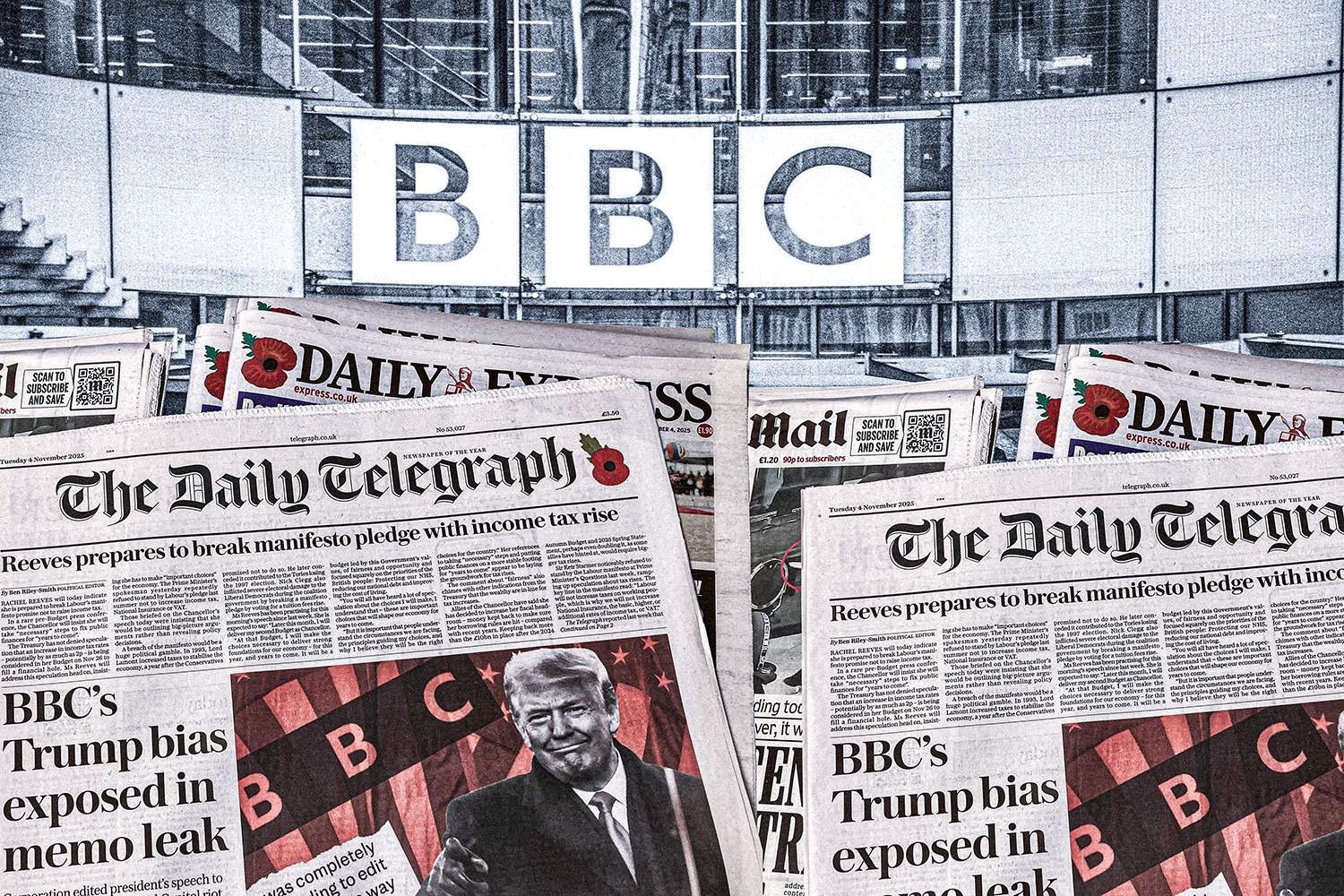
With the news agenda last week so dominated by Keir Starmer and his likely successor Andy Burnham, a highly significant Government document about the future of our media slipped out relatively unnoticed.
The document was titled Watch This Space: A New Strategic Dimension for UK Media, and it was a so-called Green Paper published by the Department for Culture Media and Sport.
It was the subject of a couple of uncontentious news items on 20 June in The Times and Financial Times, but it was a piece in the same day’s Telegraph, headed “Starmer to force social media giants to prioritise BBC and other public service content”, that gave the story legs, albeit rather crooked ones.
Significantly, the piece was written not by one of its media staff but by its senior political correspondent. This was followed by an editorial on 21 June and another opinion-heavy article on 23 June. By the following day the Shadow Culture Secretary, Nigel Huddleston (who is quoted in the latter), had initiated a House of Commons debate on the Green Paper which gave various Conservative MPs, and Reform UK’s Robert Jenrick, the opportunity to regurgitate indignantly most of the Telegraph’s main points.
So what’s all the fuss about? Briefly, Watch This Space is a consultation document which is seeking ways to ensure that “the media, and television in particular, can continue to play its vitally important role in our society and our democracy, by ensuring high-quality UK content and trustworthy news remains accessible and sustainable for the next generation”. It has been born of concern that audiences readily admit that they are finding it increasingly difficult to distinguish between fact, opinion and polemic and because of the risk that less accurate sources of news and information – in particular those driven by algorithms on social media platforms such as Meta – are displacing more trustworthy ones.
Thus the Government is exploring “legislative options to establish a prominence regime specifically for trustworthy news content on social media”. This would require social media platforms to ensure that sources of trustworthy and high-quality news are prominent and easily discoverable within user interfaces. Initiating such a process will involve, among other things, examining “how we develop criteria for a ‘trustworthy news provider’”. A similar prominence regime will be established for public service media (PSM) content on television, on whatever kind of platform or device it is watched.
All very admirable and uncontentious, one might think, particularly given the ever-increasing public disquiet about the spread of disinformation. But not for the kind of newspaper such as the Telegraph whose antennae are minutely attuned to any kind of legislative development that it perceives as threatening to introduce state regulation of the print media or as privileging public service broadcasting, and particularly the hated BBC. Watch This Space, in its view, commits both of these cardinal sins.
The Telegraph case is summed up in its 21 June editorial headed “The BBC is not a beacon of ‘public service journalism’” (note the scare quotes). This is on account of the paper’s objections to its reporting of Trump, Gaza, trans issues and anything else which doesn’t adhere to its own particular editorial standards. Its main argument is that the proposals in the Green Paper “would see the Government manipulate what the adult public sees, reads and thinks” and that:
Private companies will be made to boost artificially the content of a select band of organisations hand-picked by Labour, such as the BBC and Channel 4. As a result, space for content from national newspapers or new online creators shrinks. Could it even be the case that publications may be encouraged to sign-up to new rules in order to qualify as acceptable? Such an underhand move would be press regulation by stealth.
Heavily reinforcing the developing story’s anti-Burnham slant, the 23 June article points out that culture secretary Lisa Nandy is “a close ally of Andy Burnham”, that “as shadow home secretary under Jeremy Corbyn in 2016, he argued for a second phase of the Leveson Inquiry” and that in his by-election campaign he was joined by Hugh Grant and Steve Coogan, “who have remained closely involved in the Hacked Off campaign for the decade since”. And just to hammer home the point it helpfully adds that “any attempt by Labour to induce publishers to submit to state-backed regulation would threaten to reopen a bitter row just as Mr Burnham is poised to take power, promising a fresh start”.
This is an outcome which, of course, the Telegraph is doing its utmost to bring about. The suspicion that other like-minded newspapers will undoubtedly follow suit is given considerable credence by a quote from Theo Bamber, the CEO of the News Media Association, who states that:
While we support the Government’s intentions in wanting to get people to access trusted news, the method they are proposing here risks obscuring the high-quality, agenda-setting journalism produced every day by the UK’s independent news publishers and narrowing the range of trusted voices available to people across the country.
What we have here is not simply a pre-emptive attack on Burnham but a crude attempt to raise the spectre of Leveson and also a continuation of the remarkable process whereby some of Britain’s least trusted newspapers managed to get themselves accredited as Recognised News Publishers for the purposes of the Online Safety Act 2023, and thereby exempted from its requirements.
In order to qualify as such a publisher, an organisation has simply to be UK-based, have as its primary purpose publishing news-related material, be subject to editorial control, operate a standards code and possess a mechanism for resolving complaints. I’ve explained the manifest shortcomings of this scheme elsewhere in Byline Times, but suffice it to say here that the record of the Independent Press Standards Organisation (IPSO) of upholding standards and dealing with complaints is absolutely lamentable. Furthermore, “news-related” material is deliberately defined sufficiently broadly so as to encompass exactly the kind of tendentious opinion-mongering, dog-whistling and truth-stretching that passes for “journalism” in far too much of the national press. That the Green Paper actually suggests these requirements as a possible “starting point” for developing criteria for a “trustworthy news provider” simply beggars belief.
So for all the good intentions and admirable ideals of the Green Paper, this particular proposal represents a totally unjustifiable regulatory bung for some of the media which have done their utmost to undermine “the basis of a cohesive country and a healthy democracy”, the protection of which is Watch This Space’s central concern.
Equally importantly, it would also massively devalue the existing PSM regulations concerning prominence and the basic principle of “no public benefits without public responsibilities”. If implemented in the way suggested here, the “prominence regime” would put trusted, regulated, public service broadcast news on a par with the Sun, Mail, Telegraph and Express, none of which are regulated in any serious sense and are, according to the YouGov survey referenced above, the UK’s most distrusted national titles. The fact that they also wage unremitting war against the trusted public service broadcasters, and the BBC in particular, threatens to send the irony meter off the scale.
All of these considerations, and many more, make responding to this Green Paper a matter of urgency. The closing date for responses is 31 August.
Article and photo taken from Julian Petley at the Byline Times.
Hacked Off is funded by supporters, not newspaper owners. Help us take this to Parliament: give £10 a month.
Give £10 a monthBy submitting your details you agree to receive email updates about the campaign. We will always keep your data safe and you may unsubscribe at any time.
.png)

.png)